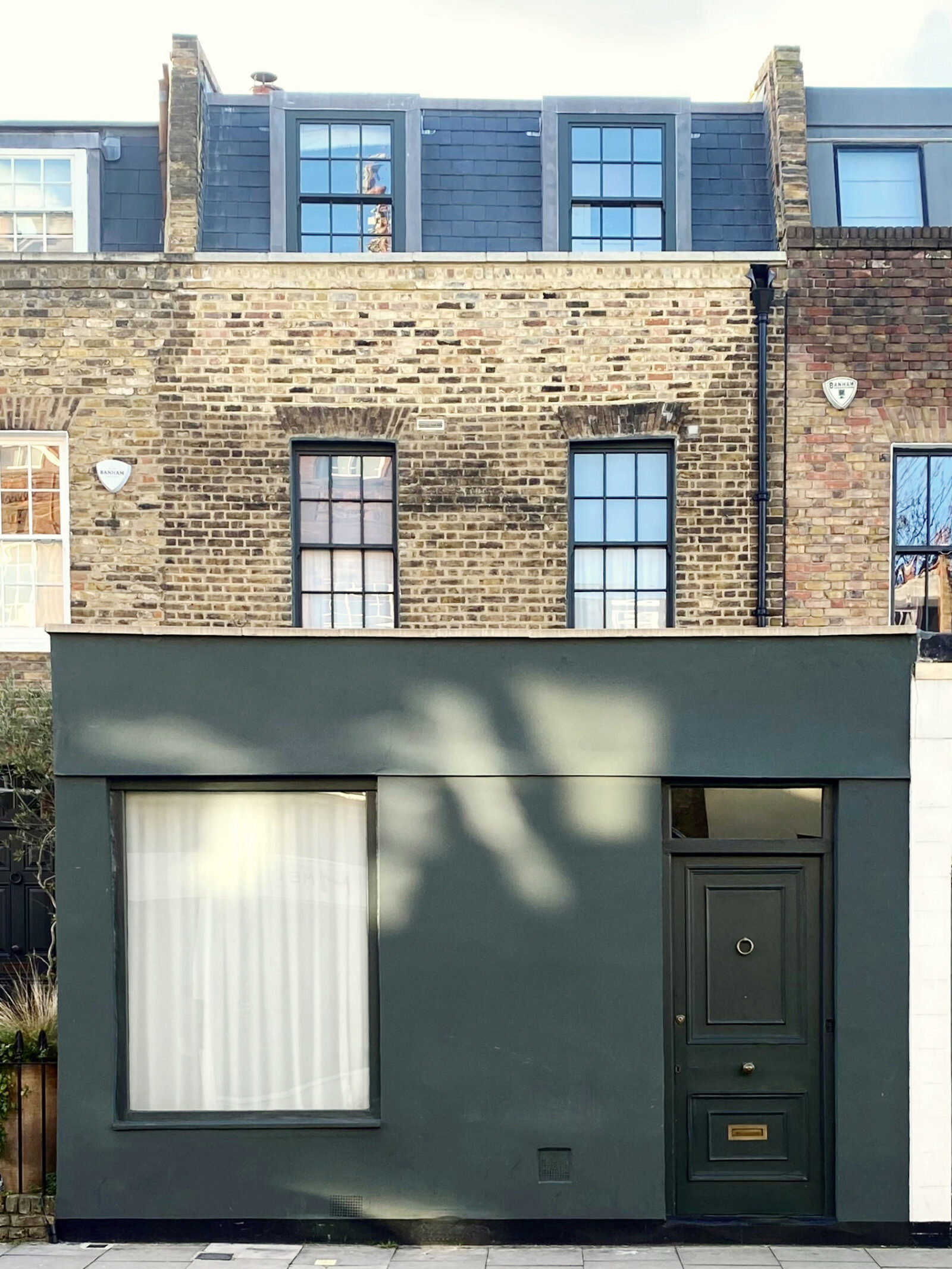
The house is accessed via a dark green-painted front door of imposing proportions, reclaimed from a 19th-century bank, the colour blending with the sedate tone of the former shop-front façade painted in Farrow and Ball’s ‘Studio Green‘. It opens to a deep welcoming hallway, painted in striking ‘Picture Gallery Red‘ by Farrow and Ball with smart, chequerboard-painted floorboards underfoot. The thick, enveloping walls of the façade create a sense of removal from the street and introduce the cloistered peace of the house beyond.
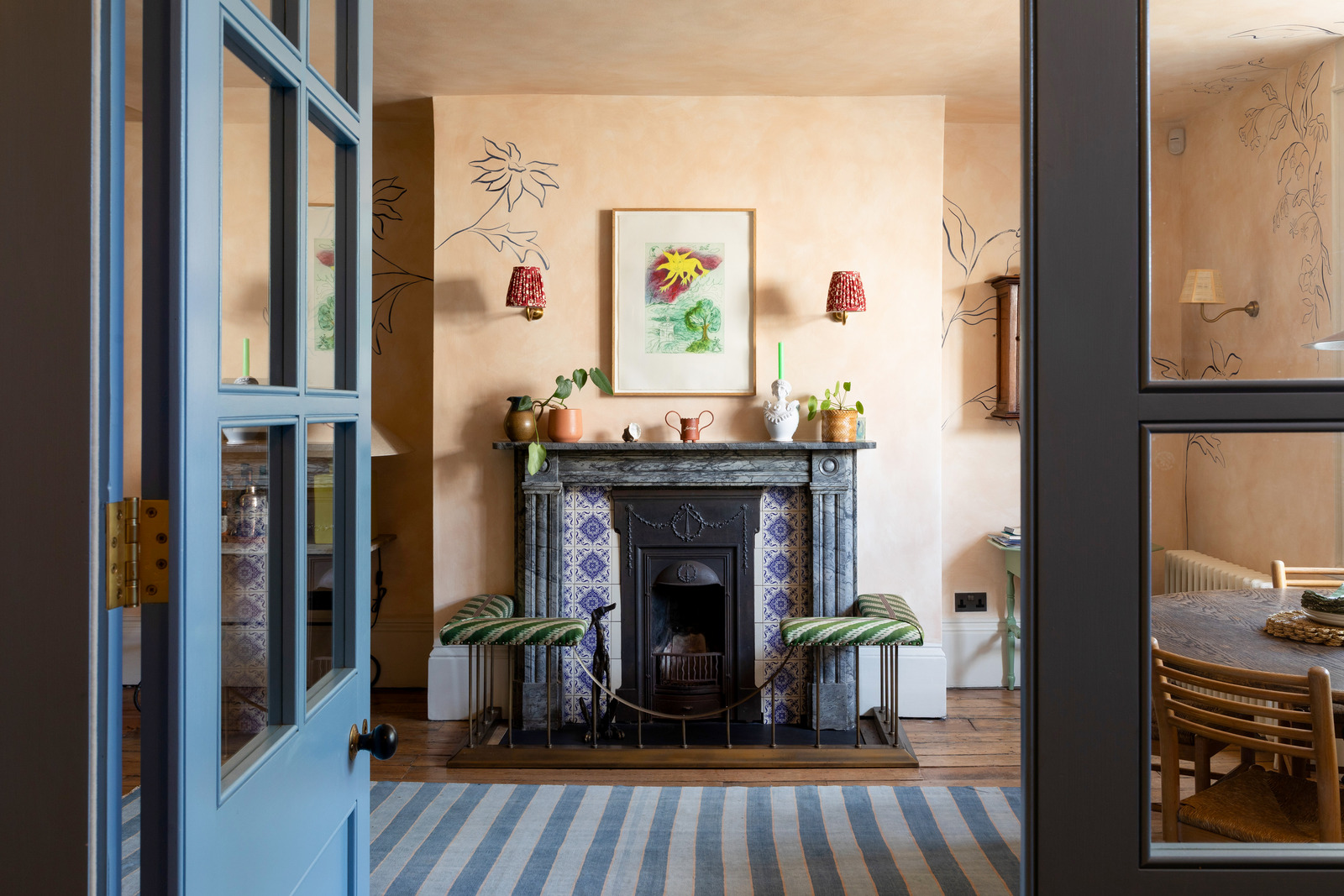
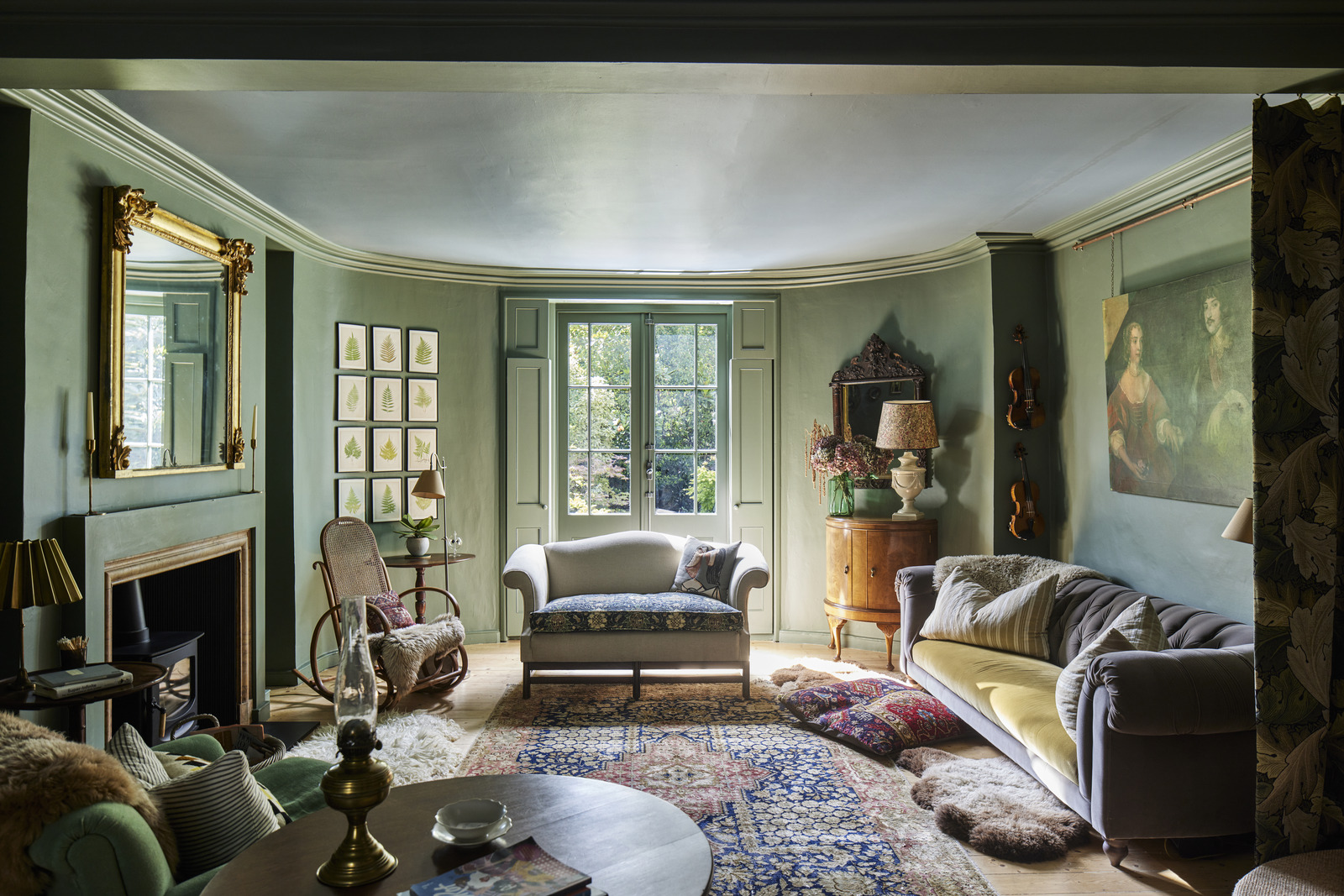
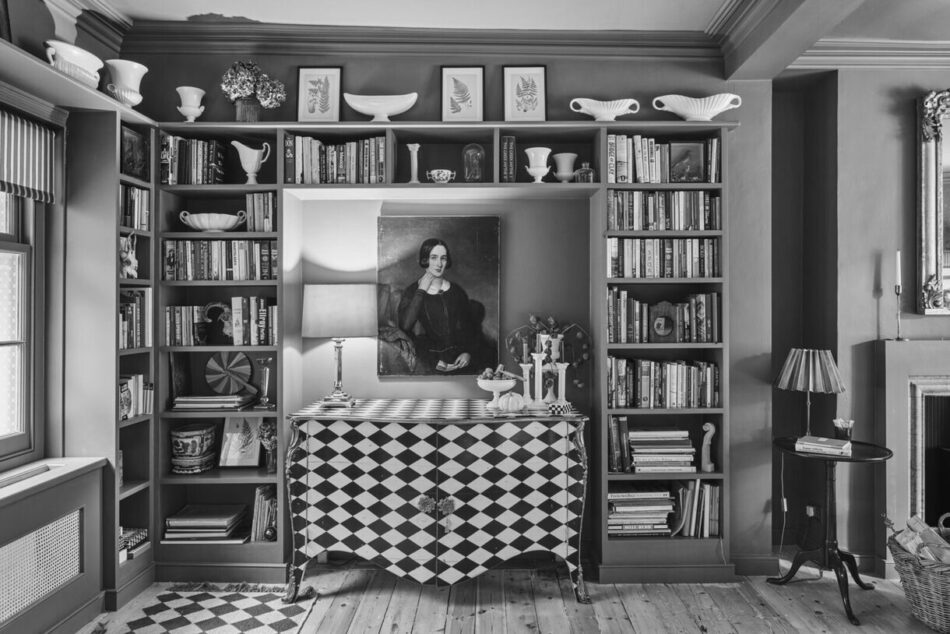
The hall opens onto the drawing room. Here, walls are painted in Farrow and Ball’s ‘Green Smoke‘ while the ceiling is picked out in delicately contrasting tones of ‘De Nimes Blue‘, also Farrow and Ball. Sanded original floorboards run underfoot, while a focal point for the room is created by a handsome mantelpiece framing a sturdy Charnwood C-5 Wood Burner ensconced within the original hearth. Fluted cornice moulding draws the eye upwards, and a gently curving rear bay with French doors opens to a small first-floor terrace overlooking the verdant garden. Bespoke joinery frames the edges of the room and provides ample space for books and beautiful objects.
A staircase descends to the open-plan kitchen, living and dining room. The current owners’ passion for culinary creation led them to design the bespoke space with the help of Vinycomb Bate, resulting in a room that is both useful and beautiful – a “real cook’s kitchen”. Hardwood joinery wraps two sides of the main room and is painted in ‘Treron‘ by Farrow and Ball, topped with an English oak work surface and further equipped with Perrin and Rowe instant hot taps. A dark green island has been cleverly conceived on locking castor feet so that it can be moved throughout the space depending on requirements. A rear kitchen and larder/ culinary is a rare delight. With internal windows shedding borrowed light on the perfectly formed space, further joinery and shelves provide ample spaces for food preparations, storage and displaying a carefully curated crockery collection as well as a laundry and WC. Beams have been exposed throughout this floor and painted white open shelving for cookbooks adds height to the room.
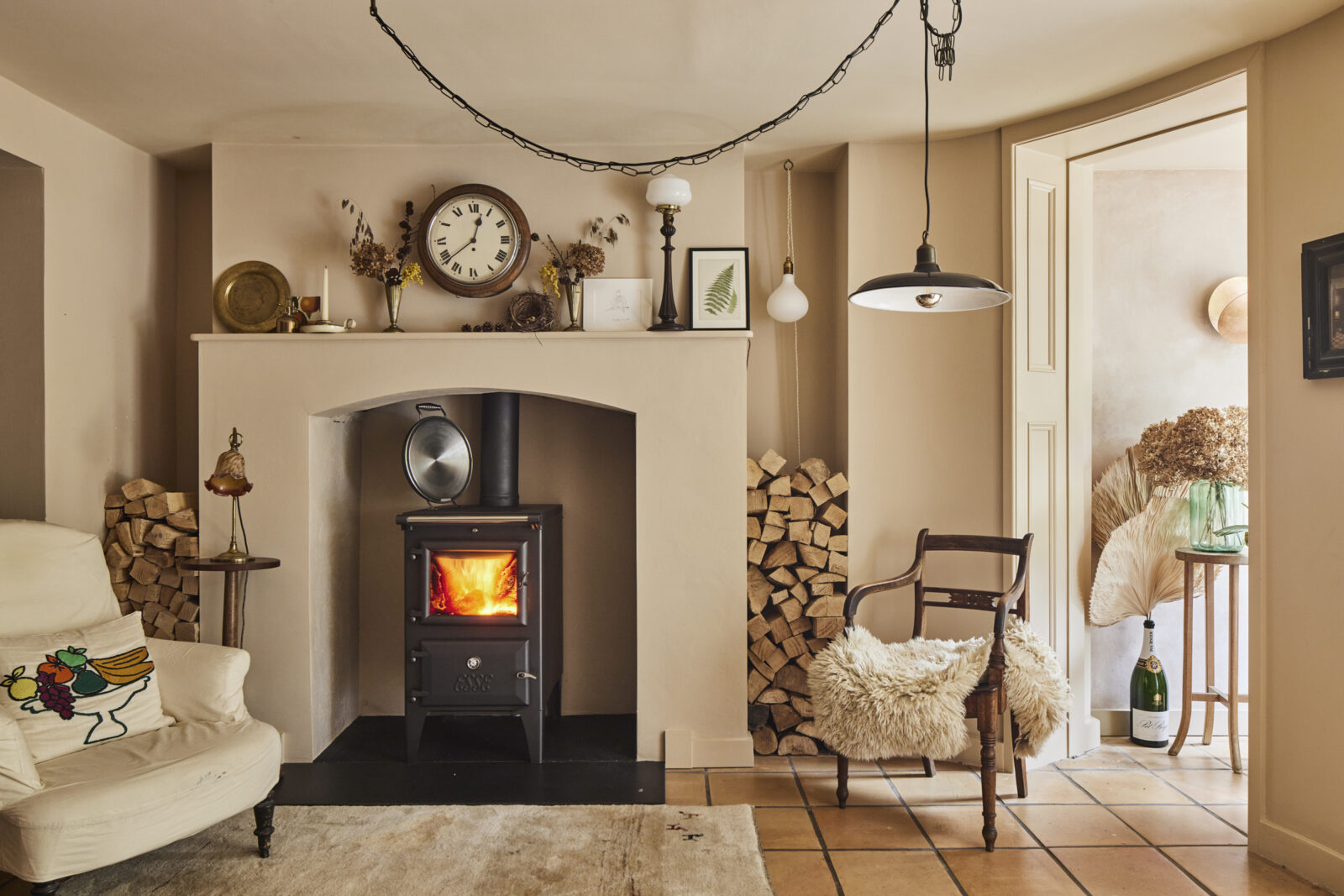
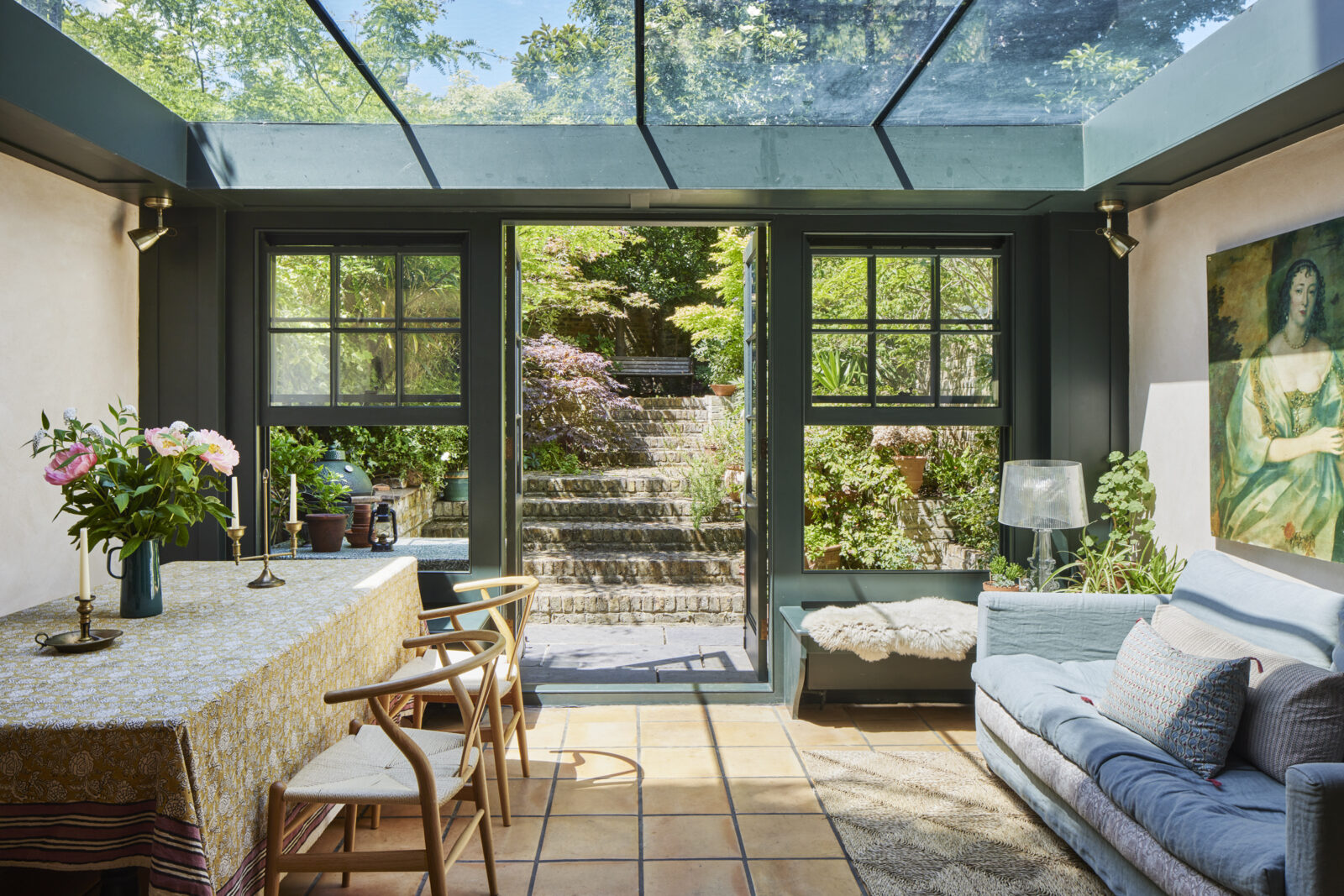
The kitchen space extends into an open entertaining area centred around a stuccoed chimney breast. Painted in warm tones of ‘Archive‘ by Farrow and Ball, this entire floor is laid with warming terracotta tiles, and an ESSE Bakeheart wood burner is set into the hearth. At the back of the plan is the garden room. Here the warm tones of Archive are accented by textured walls clad in a sand and cement finish. The entirely glazed roof floods the space with natural light throughout the day. The mature West-facing garden, planted for year-round colour and interest, rises gently from the rear of the garden room creating a verdant backdrop. The garden room has ample space for a large table with built-in banquette seating extending along two walls.
The first floor is given over entirely to the principal suite. Here, a sash window is set into the curved back wall and overlooks the garden. The leafy views are amplified by the soft tones of French Gray on the walls and the stripped floorboards. The same colour continues in the calming shower room next door, creating a clever sense of continuity. A wall with a built-in arch defines the shower space, which is clad in gray and white Emery and Cie tiles. Bespoke cabinetry houses a double basin sink with an Iroko top and creates plenty of storage. Accents throughout the room are in a vibrant tone of ‘Radicchio‘ by Farrow and Ball, adding drama and finish to the space.
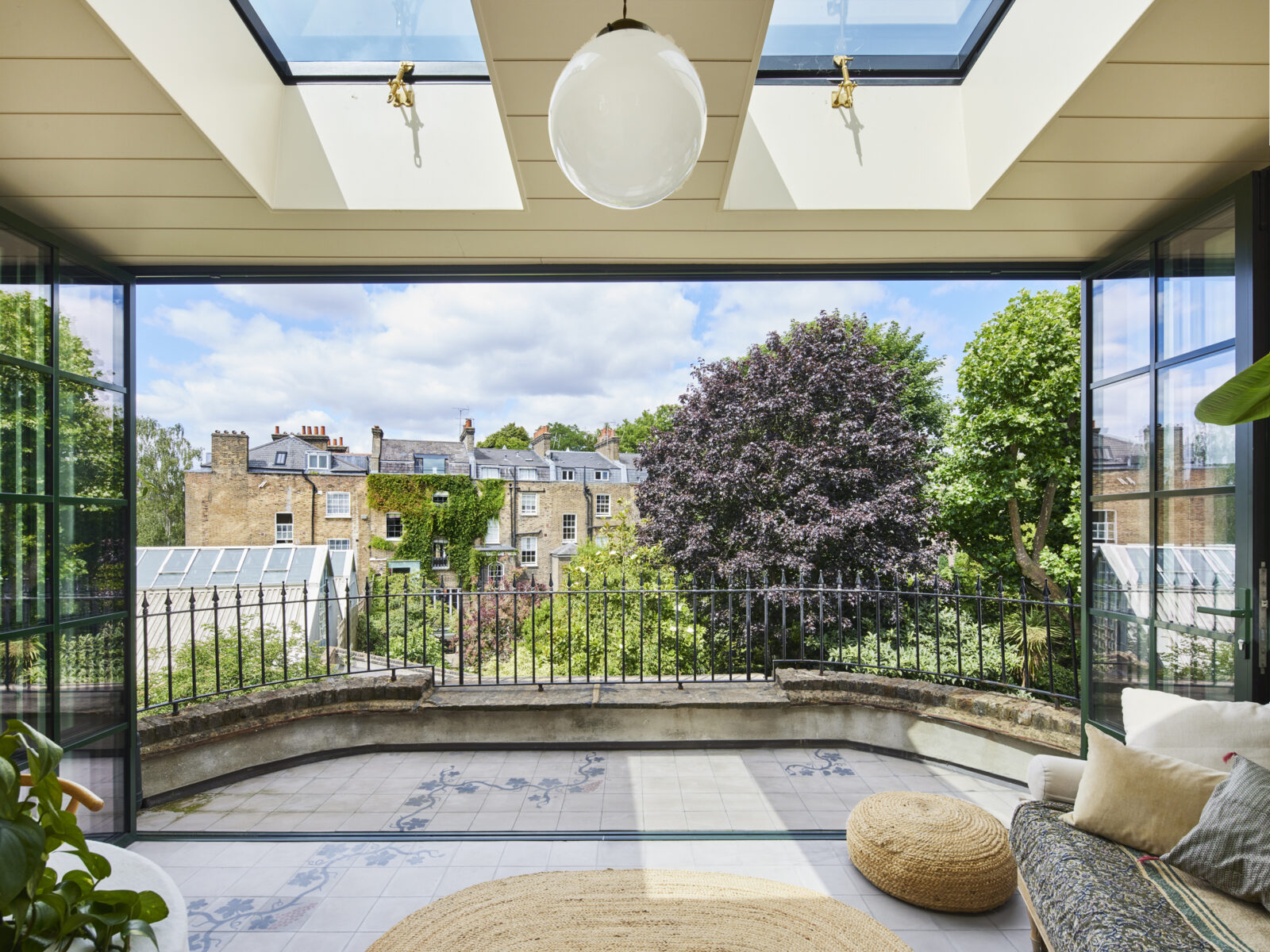
On the second floor are two bedrooms. One finished in ‘India Yellow‘, with views to the front over neighbouring rooftops. The studio bedroom to the rear is a defining space: floor-to-ceiling bespoke aluminium bi-folding doors by IQ Glass open onto a terrace. Creating a dramatic effect with their dark panes when closed, when opened in their entirety, an ‘inside out’ room takes in far-reaching views across the garden and period rooflines beyond. The high set position means the room is filled with light throughout the day, yet still kept cosy in the winter by the heated floor. A further shower room on this floor is rendered in soft mushroom-toned micro-cement with an interior stained-glass window featuring the angel Gabriel that shines with borrowed light.
On the ground floor, a sensitive renovation of the space that was once the shop front has created a bedroom and a WC in the hall, allowing for a private suite for guests when needed. The separate nature of the front bedroom makes it perfect for versatile use as an office or music room.
The Great Outdoors
Doors open from the garden room to the tiered mature garden, which is wonderfully positioned to catch the sun throughout the day. Planted with a variety of ornamental acers, angelica and magnolia, the layered effect of the mature borders means the garden feels like a quiet oasis in the heart of the city. A paved seating area is close to the house, perfect for alfresco dining, and stone steps lead to a raised patio to the rear.
Out and About
Liverpool Road lies in the centre of Islington. Upper Street is home to an abundance of amenities, from Ottolenghi to Gail’s, the Almeida Theatre to The Old Red Lion Theatre & Pub as well as the King’s Head Pub Theatre. The charming Compton Arms and the wonderful Union Chapel are both a minute’s walk from the house, along with the Pig and Butcher. For art, the Estorick Collection of Modern Italian Art is only a short walk away. Third Space gym is also a four-minute walk from the door. An excellent independent cinema is found at Screen on the Green. There is a multitude of delis, wine shops, florists and bakeries on Liverpool Road, as well as two excellent fishmongers, Steve Hatts and Moxon’s, and Turner & George butchery.
Islington High Street and the excellent Camden Passage are also close by. The area has some very good gastropubs, including The Drapers Arms and The Albion. Bellanger is nearby on Islington Green. Camden Passage and Chapel Market both have farmers’ markets on Sundays.
The lush and expansive Highbury Fields is a short walk or cycle away and the area is well placed to easily reach Exmouth Market, Coal Drops Yard, Barbican, and Clerkenwell.
The area enjoys excellent access to public transport, including several main bus routes to the City and central London. The house is an eight-minute walk from both Highbury & Islington (Victoria Line) and Angel (Northern Line). The Eurostar at King’s Cross St Pancras is also easily accessible, as are London’s airports.
Council Tax Band: G

 Related Stories