


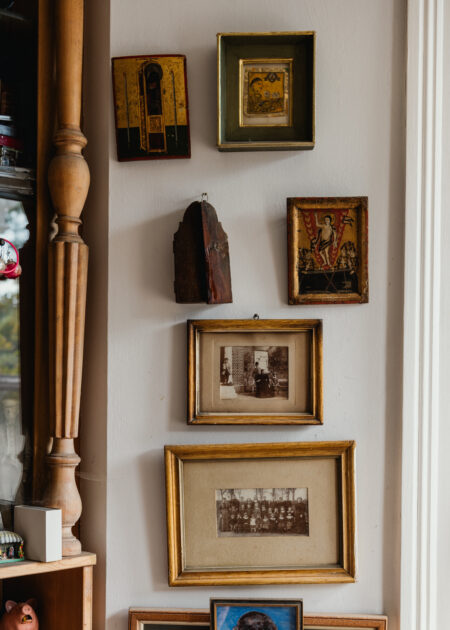
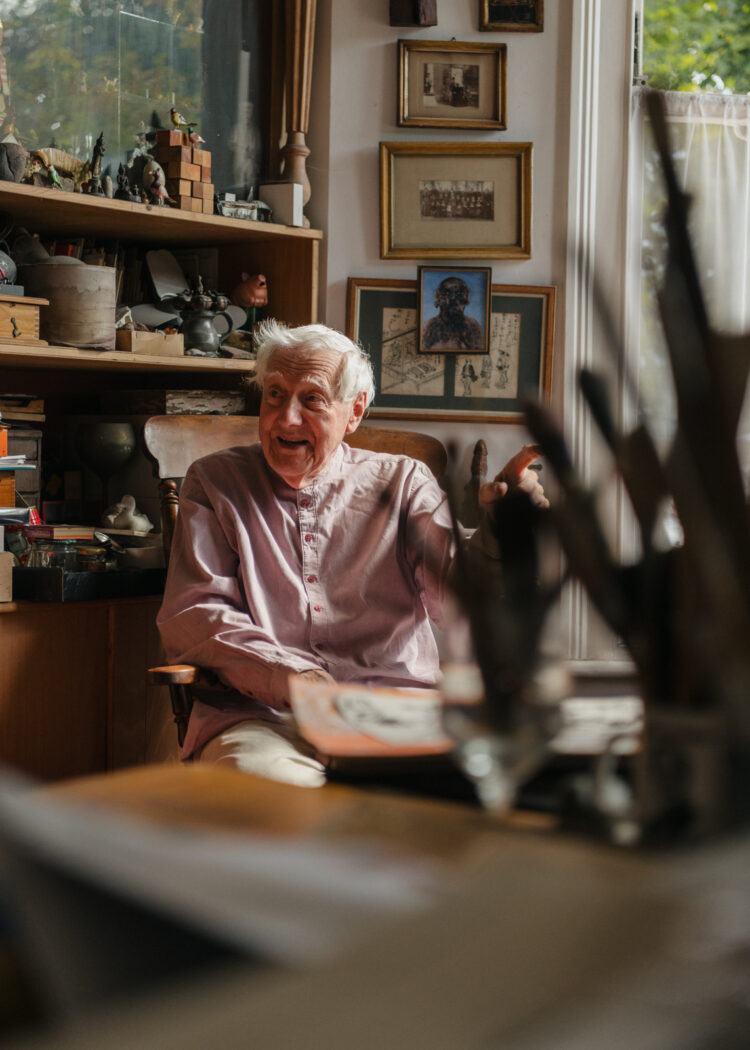
They say that all work and no play makes Jack a dull boy. But work and play? Well, Roddy Maude-Roxby – who’s spent eight decades doing both – is anything but boring. An acrobat of a conversationalist, Roddy is a marvellous storyteller with a deep well of anecdotes. Ask him a question and who knows where you’ll end up. If not by design, this trait has certainly helped forge his reputation as a pre-eminent improviser and a trailblazer of British performance art. As a painter, it’s lent his work a rare immediacy. As an actor, however, it has occasionally caused him problems. “I was hopeless at learning lines,” he laughs. “I never did it.” Somewhere, he says, he has a rejection letter from the Royal Court for a role on account of his “aptitude for clowning”.
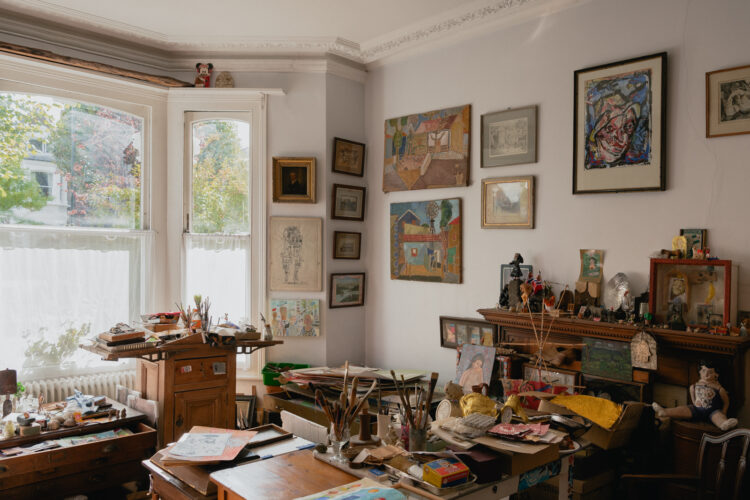
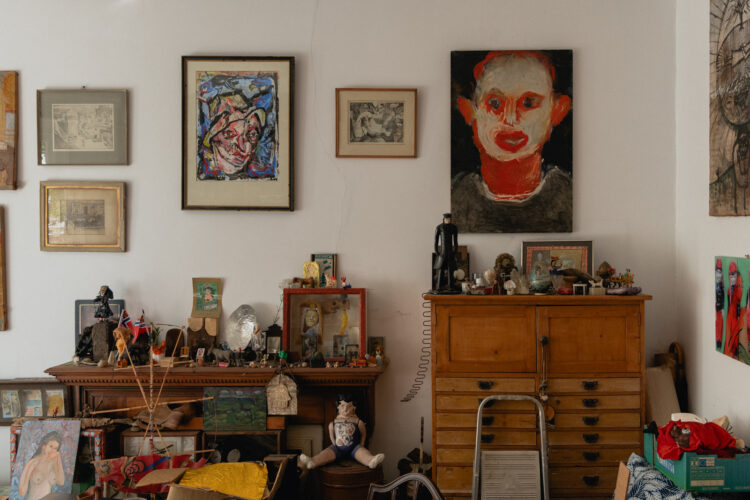
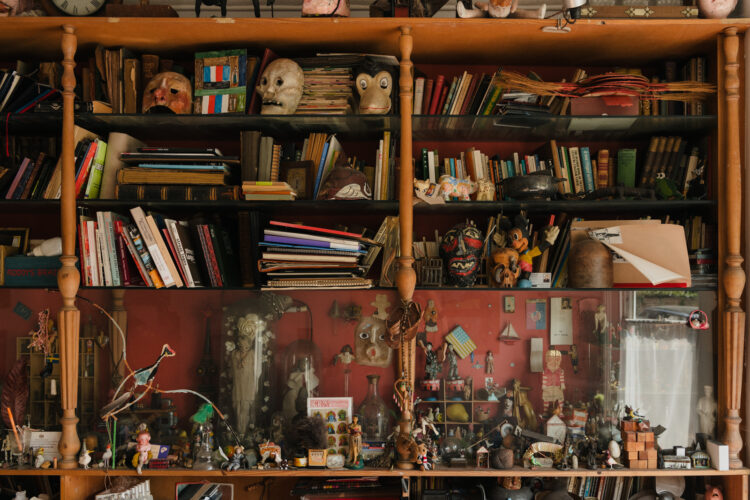
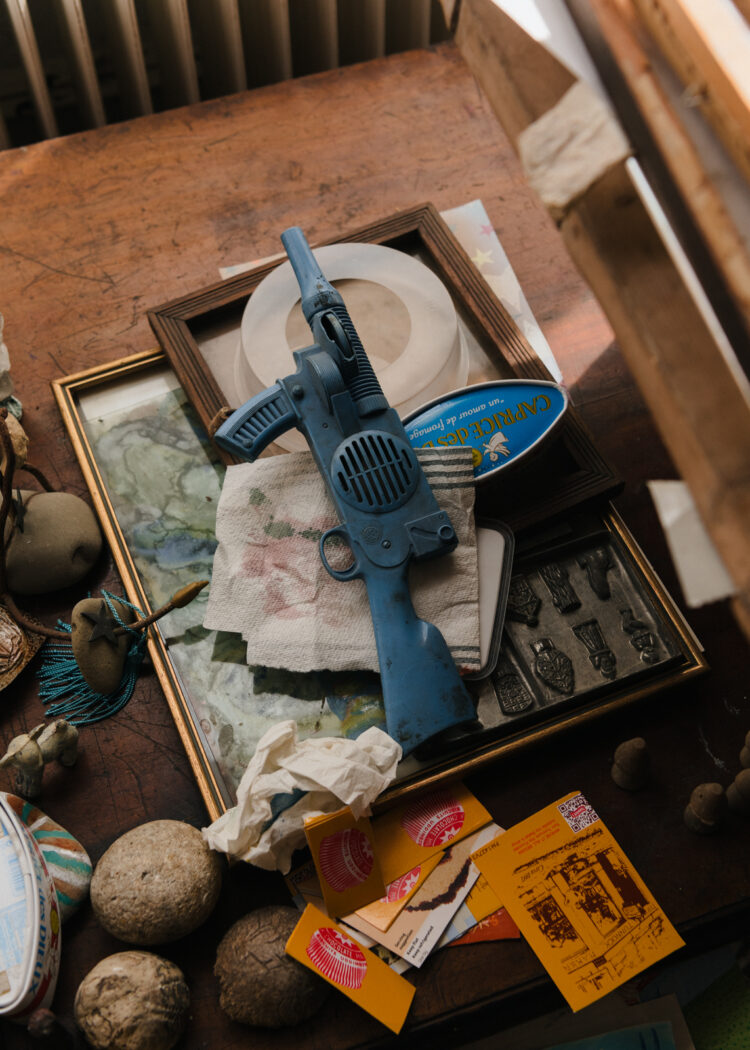
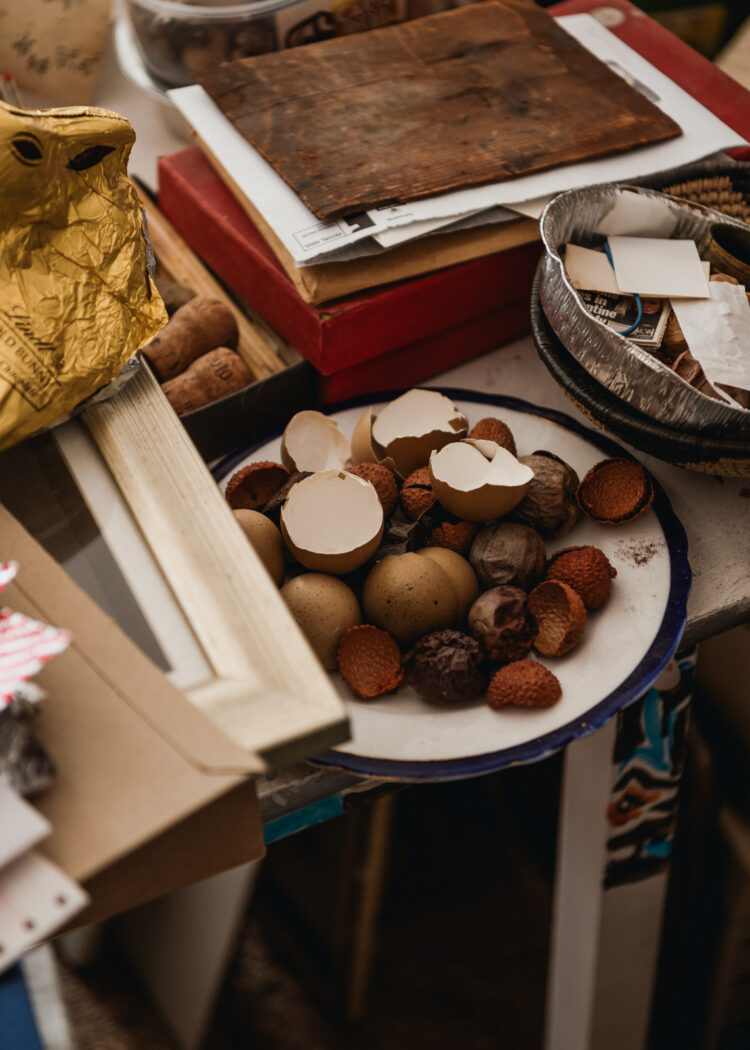
No matter. It’s hardly as if Roddy has been short of work (many readers may be delighted to learn he voiced Edgar, the butler and hapless villain in Disney’s The Aristocats). In fact, he’s packed more into his career than most 93-year-olds – and he’s still going; the second run of his most recent exhibition, Associative Drifts, has just closed and he’s now thinking about what’s next. His studio in which we sit now, a large downstairs room in his house in south-west London, is filled with the flotsam and jetsam of his creative endeavours. Models, masks, found objects. For Roddy, the carapace of a lychee, an old eggshell, a glinting Tunnock’s Teacake wrapper can act as much of a springboard as any art book (though he’s plenty of those too).
Work (or is that play?) began early in Roddy’s life. Born in London in 1930, by the time he was 13 he had written two children’s books about the adventures of a frog named Bulgy (they were both published by the time he was 15) . At 17, now living in Melbourne, Australia, he edited a page for The Age, drawing Bulgy comic strips for kids to colour in at home. The newspaper also had a radio show for which Roddy was asked to provide the voices of any English characters in the Goons scripts it had been sent to record.
It was around this time that Roddy went to the Australian painter George Bell for lessons. “He noticed that I was adding black to green to make it darker, despite not having been taught to do so. He showed me the work of le douanier Rousseau and he told me, ‘If you keep going and avoid going to art school, you’ll be in the running to be in the envied position where you’re making art entirely uninfluenced by anyone else.’”
The idea of being an outlier appealed to Roddy, an eccentric in the proper sense (the word comes from the Greek ek, ‘out of’, and kentron, ‘centre’). That said, despite Bell’s advice, Roddy did end up at art school on his return to London – first at Heatherley’s then the Royal College of Art. It was here, in the 1960s, that Roddy found himself part a cohort of enfants terribles intent on doing away with the great traditions of fine art – and were very good at dismaying their teachers in the process. “They were appalled that we looking to the likes of Jackson Pollock and Willem de Kooning,” he says, recalling a time when he, David Hockney, William Green and RB Kitaj were read the riot act by their teacher Carel Weight. Green had made one of his bitumen and paraffin paintings, smudging the wet surface by pushing his bike over it then setting fire to it. Weight came in having smelt smoke to find the boys had put the smouldering painting in a bin. “The staff were horrified that people like us could be given grants to study,” Roddy says, still tickled at the memory.
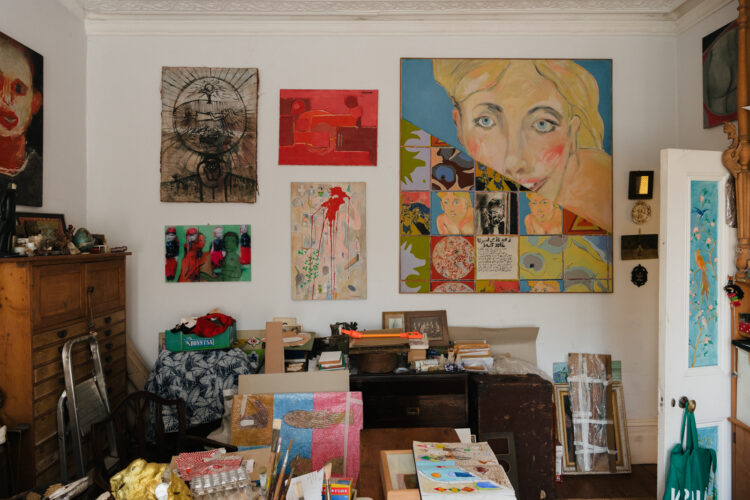
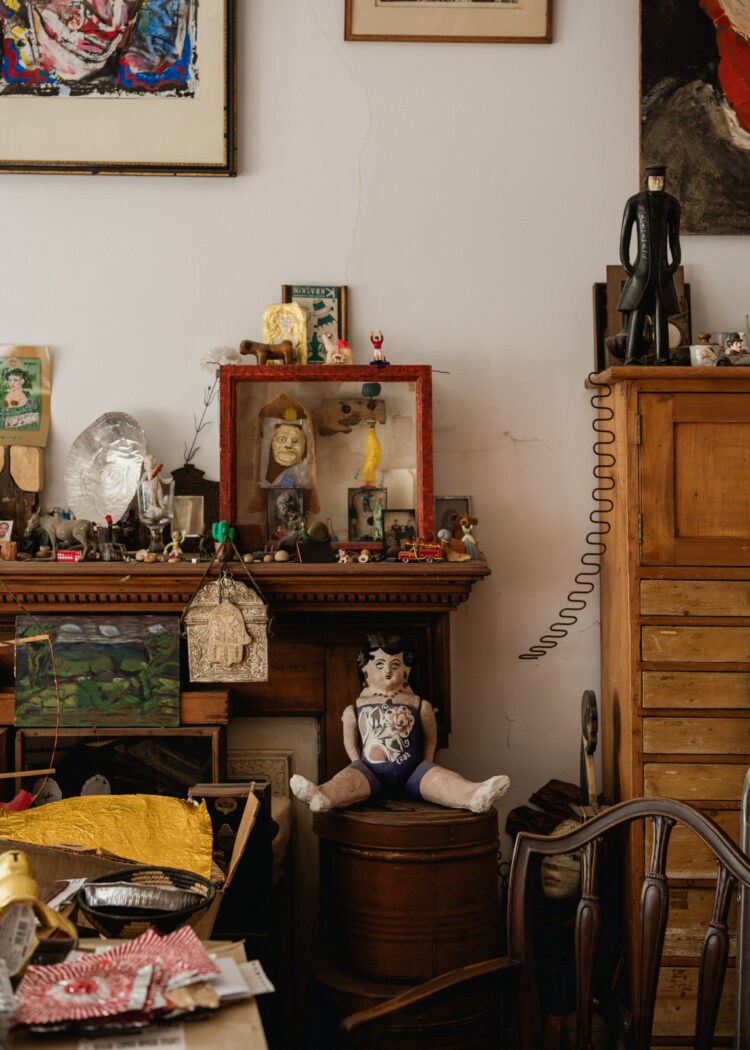
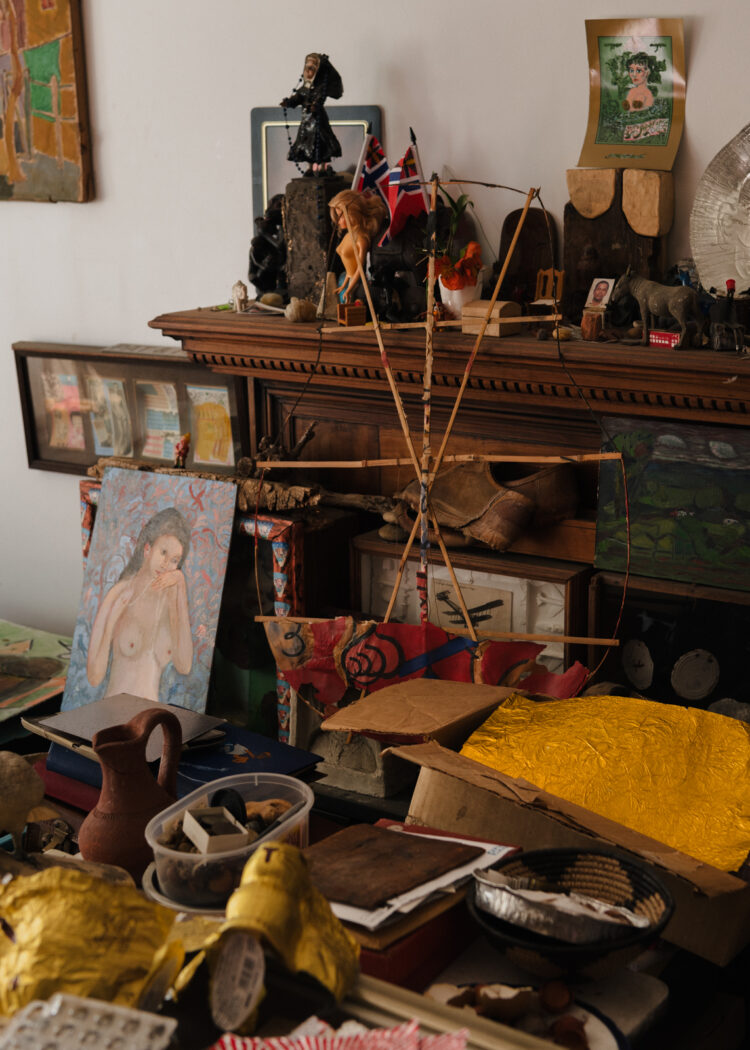
Flatness was Roddy’s goal. Interested in achieving something of the plane-squashing space of Jean Dubuffet, he started producing striking mask-like portraits “that really annoyed the college”. Once, he strapped a picture to the roof of his car to take it home, only for it to blow off in South Kensington and get run over by a bus. “If the board hadn’t broken, it would have been perfect.”
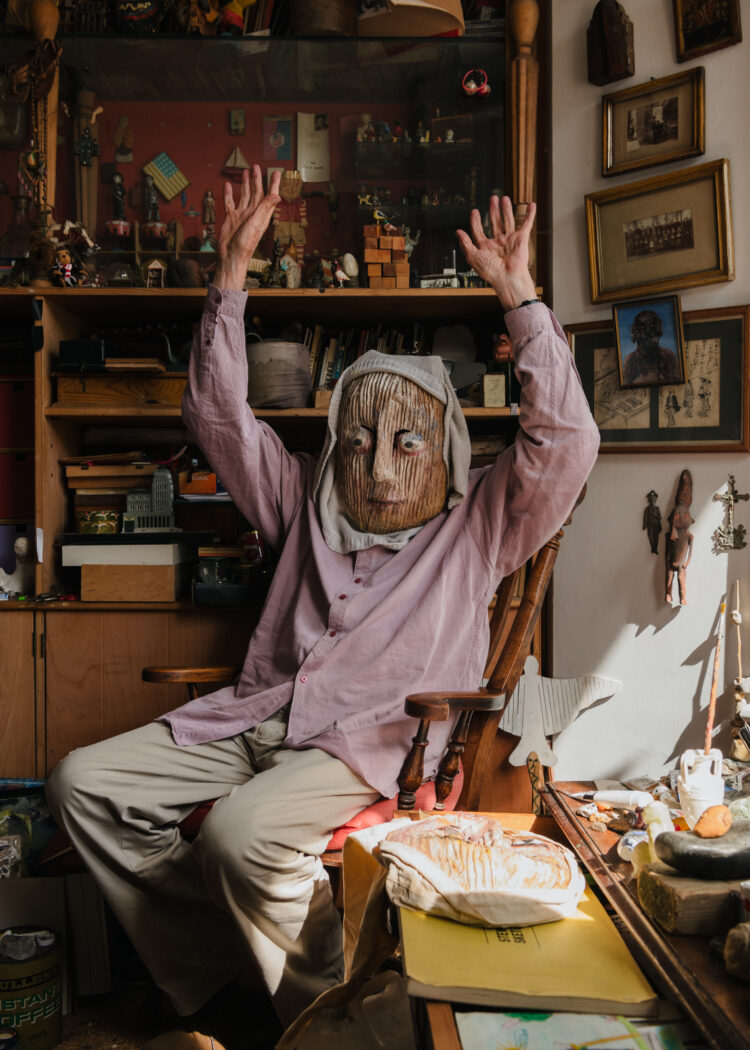
Part of his artistic explorations at the time saw Roddy setting up the RCA’s revue show, a series of skits and improvised scenes produced at the end of the year. It was envelope-pushing stuff and, for many, “their first sight of performance art”. It wasn’t necessarily to everyone’s taste – “one of the sketches involved someone vomiting on stage” – but soon Roddy found students from abroad asking to take part. “There was something going on of which we weren’t aware,” he says. It captured people’s imagination – so much so, in fact, that Roddy launched his acting career off the back of it, starting with a stage role in NF Simpson’s One Way Pendulum, a surreal caper surrounding an imaginary murder trial (he would go on to star in the TV adaptation). Later, he would go on to co-found, with Keith Johnstone and Ben Benison, the enormously influential countercultural improv troupe Theatre Machine, which placed heavy emphasis on mask-work. “Masks make you realise that you’re being seen as someone else, so you needn’t be so much yourself.”
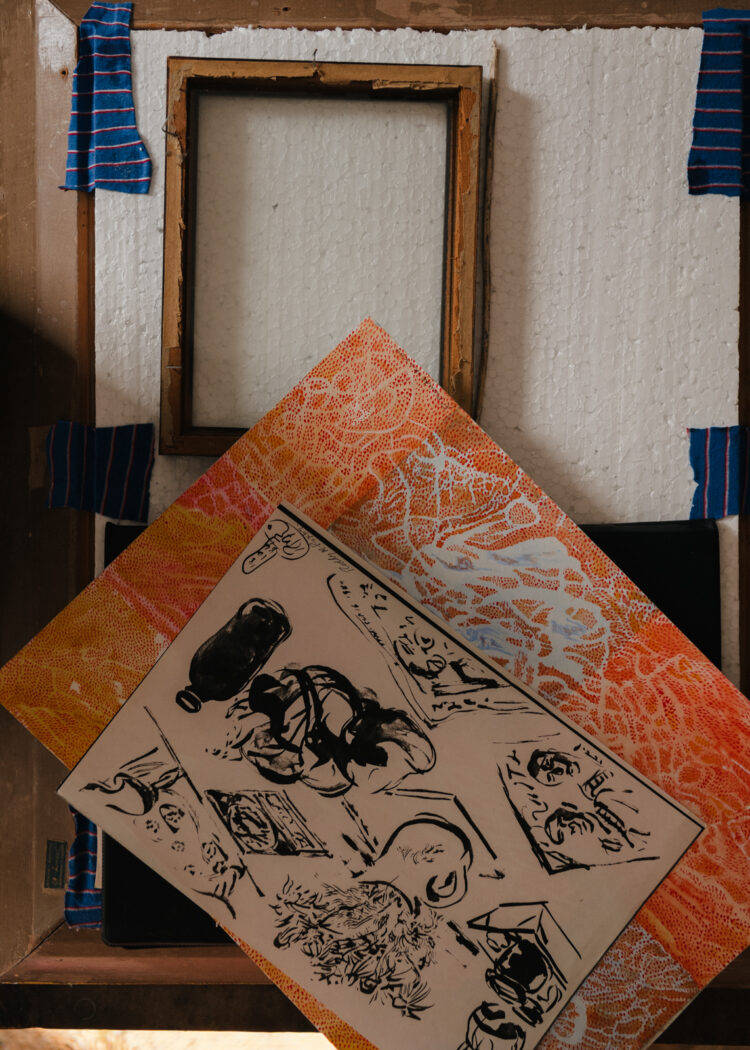
For Roddy, art and improvisation are extensions of the same idea. “It’s the same game in a different language,” he explains. “Both are on the move, both are about communication, both go beyond words into something more fundamental.” Painting, like improv, is entirely reactive. “It’s like a conversation with shopkeeper,” he says, when asked what the knack to ad-libbing is. “You don’t know how you’re going to answer until you’ve been asked the question. It’s not scary, it’s just full of possibility.” (He says he found acting with a script and lines to learn much more terrifying.) Similarly, when he’s painting, Roddy is always “waiting for suggestions from the marks I’ve just made”. Intuitive and process-led rather than preconceived, his painting is entirely without contrivance – evidenced by the cardboard works he’s been creating lately, largely blanked out with white paint except for a few selected shapes from the printed packaging – a wolf, say, or a piece of fruit. What comes next is anybody’s guess.
There’s something of the ‘exquisite corpse’ – the game invented by the Surrealists, where participants pass a piece of paper round, taking turns to draw the head, shoulders, body etc, folding as they go – to these pictorial riffs, free from the weight of expectation. Perhaps there’s a parallel to be drawn between this propensity to work instinctively and the subconscious-seeking obsessions of the Surrealists, though Roddy is in fact much more interested in the work of the Dadaists: the spontaneous nonsense poems of Tristan Tzara and Hugo Ball, performed in ridiculous automaton costumes or with cones for faces, for instance.
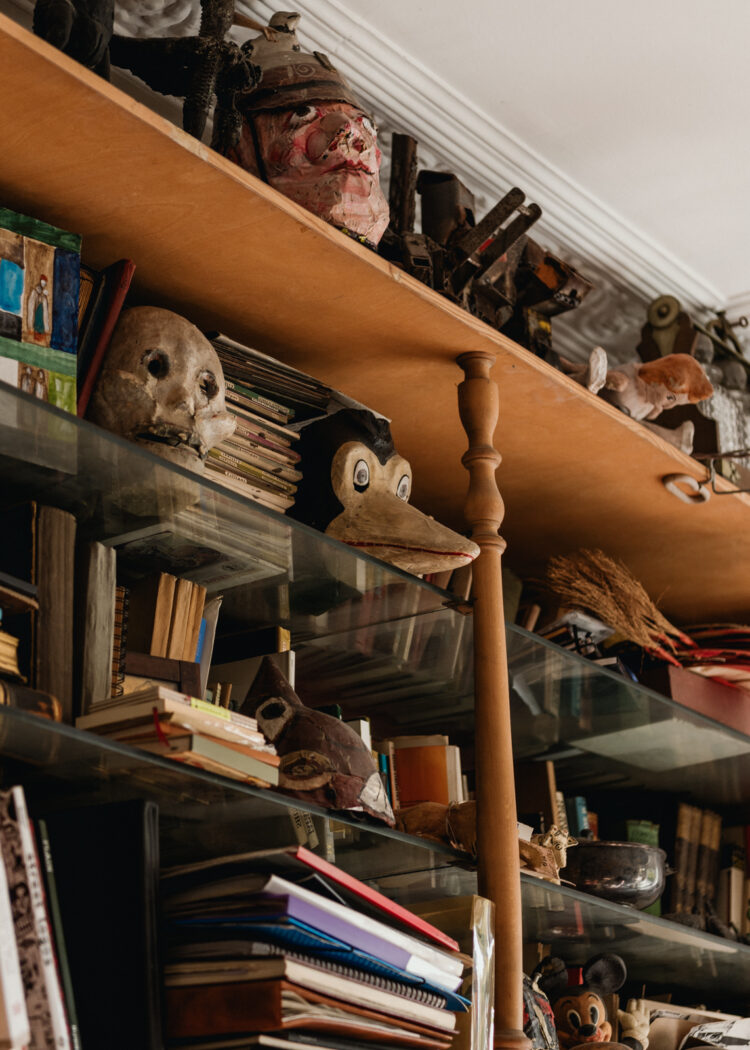
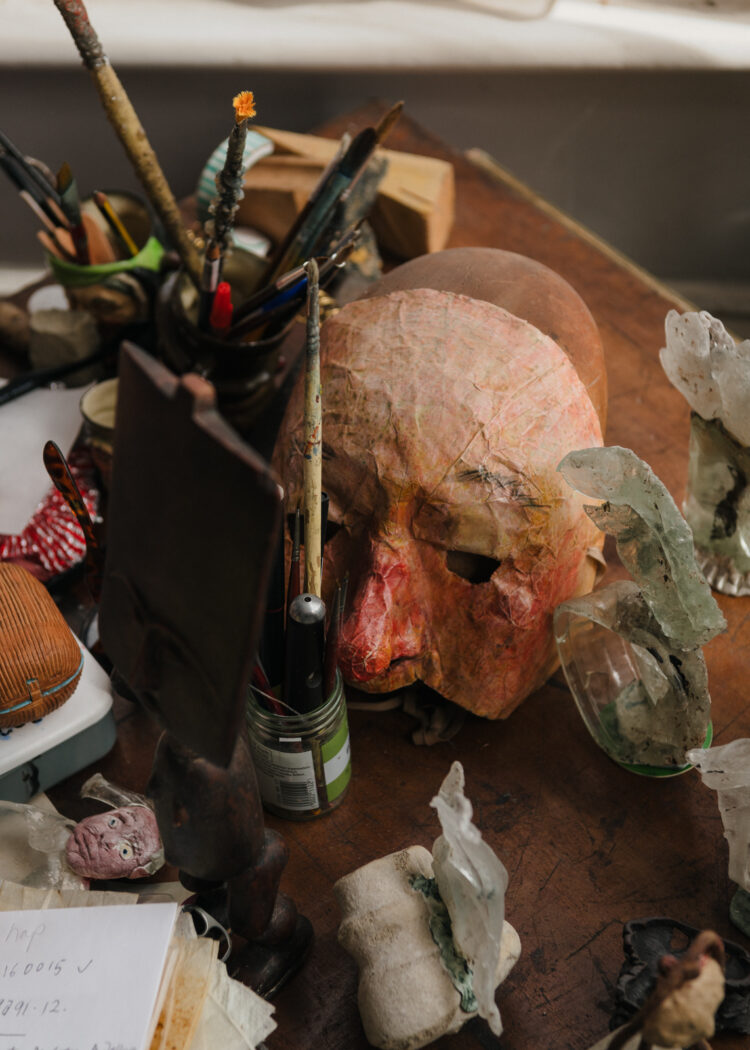
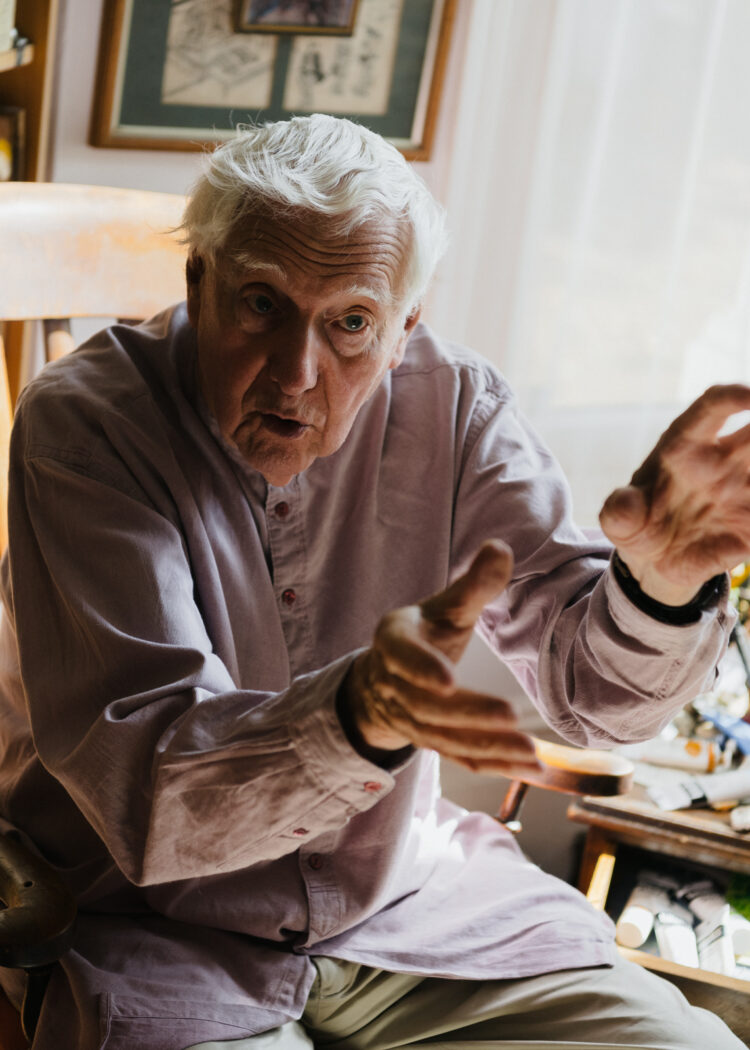
Talk of Dada brings Roddy neatly back to masks, a preoccupation since his uncle put a slashed football on his head to cheer up him up as a sick seven-year-old. “As a performer,” he explains, “they’re fascinating.” Put on a mask and the audience’s perception will immediately shift. “The atmosphere becomes more dreamlike. You move several steps further from reality.” As a consequence, “you may start to see the chance to do something different. You might even do it without thinking about it. Opportunities appear.”
Such opportunity is what art is all about to Roddy. To others less skilled, it would be petrifying, but to him, stepping into that shimmering spot beyond our sightlines is more than exciting; it is, as he has already said, “beyond words”. The infinite potential for creativity it brings is what he has spent his life’s work in search of. It’s been fruitful, certainly, but boy, it’s been fun too.
Want to see more?